What the research says
Two numbers might explain a lot about how you're feeling right now. Roughly 44% of athletes never return to their sport after an Achilles rupture. And among the ones who don't, the single most common reason given is fear of reinjury, ahead of pain or stiffness and ahead of life circumstance[1]. Not physical inability. Fear.
That fear is not a minority experience either. More than half of people recovering from an Achilles rupture report it, and the ones who do score measurably worse on the standard recovery scale for this injury[2]. The fear is not sitting beside your recovery. It is part of it.
And if you're managing T1D on top of it, the fear compounds. Fear of the injury happening again. Fear of the metabolic chaos. Fear of going through all of it, the surgery, the boot, the endless PT, a second time.
But here's what I really want you to hear.
Your grief is real grief.
When a severe injury strips you of your sport, you aren't only losing an activity. You're losing a primary piece of who you are. The American Psychological Association defines grief as anguish experienced after significant loss, including loss of identity, physical autonomy, and the roles that define you.
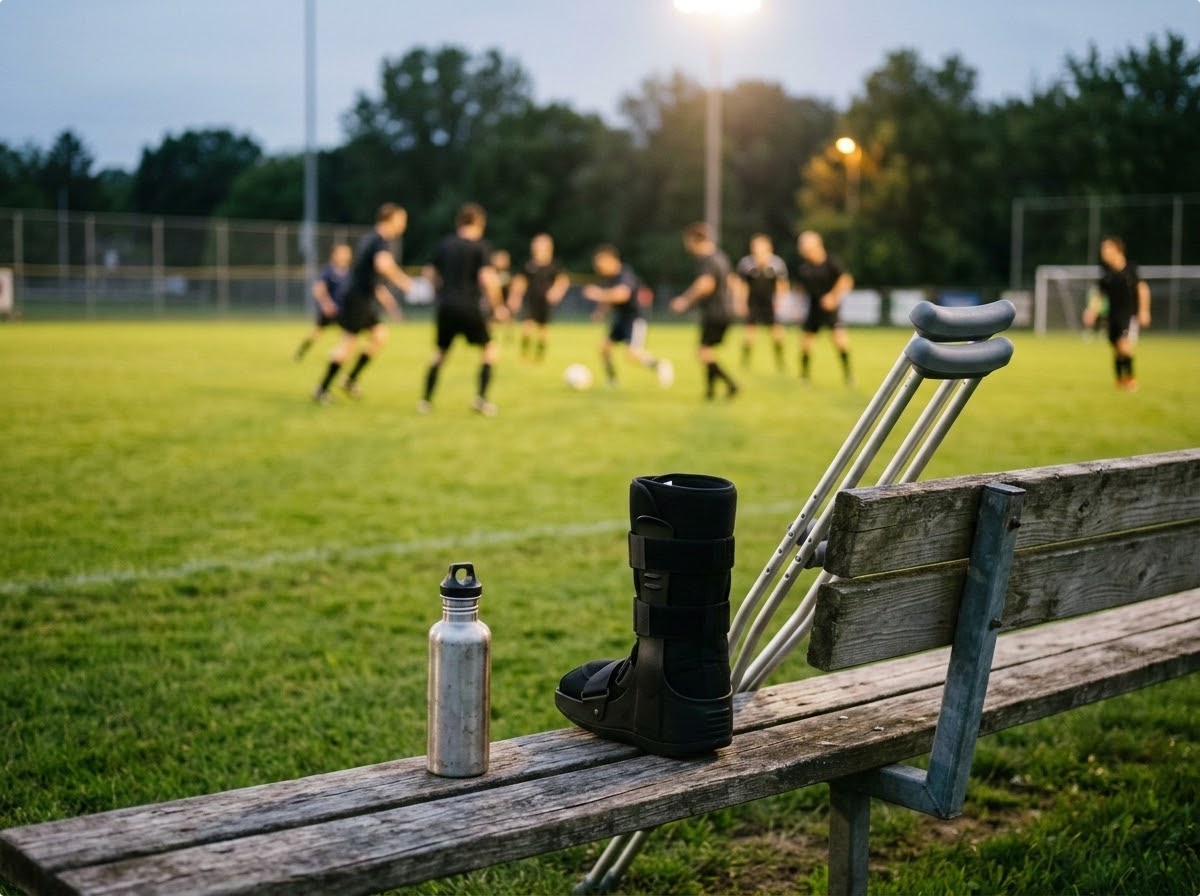
For recreational athletes, the sport provided physical conditioning, aggressive physical release, and tribal belonging. All of it, gone in one moment.
Grieving a sport other people call "just a hobby"
Here's what makes it worse. Because you're not a professional, people minimize your loss. "You can find another hobby." "At least you still have your career." "It's just a game."
This has a name: disenfranchised grief. It's loss that isn't publicly validated. And the failure to process this grief leads to clinical depression, anxiety that won't let go, and disruption that lingers far longer than the physical injury.
You know this already, don't you. You felt it every time someone shrugged off your loss. Every time you didn't have the words to explain why this hurts so much.
Your main coping tool was the thing you just lost
For someone who has lived with T1D for decades, the injury creates a dual burden. Your primary tool for managing blood sugar, stress, and diabetes distress was exercise. The Achilles rupture removes that tool entirely.
Without it, insulin resistance spikes. Glucose becomes erratic. Diabetes distress escalates. You're managing an unruly chronic condition while rehabilitating an acute injury, with your main coping mechanism gone.
Research confirms this creates a bidirectional spiral: chronic illness complications affect mental health, which affects recovery, which affects chronic illness management. Around and around.
This is hard. I'm not going to pretend it isn't.
Your T1D experience is actually a superpower
And yet.
All those years of T1D management built something in you. Executive-level self-management skills: constant monitoring, real-time problem-solving, metabolic math, emotional resilience under daily pressure.
The self-coaching frameworks used in sports psychology rehabilitation? Goal setting. Imagery. Biofeedback. Adjusting on the fly when the plan doesn't work. You've been practicing those for decades. Every single day.
The therapeutic objective, and this is the part that matters, is to transfer those chronic-care skills into the acute injury context. You already have the toolkit. It needs redirecting, not rebuilding.
So your grief is valid, seen or unseen, because this wasn't just a hobby. It was identity, community, and metabolic medicine at the same time. Fear of reinjury being the number one reason athletes don't return means your fear is the normal response, not the weak one. And the skills that kept you alive with T1D all this time are the exact skills that get you through this.
Name what you actually lost
Write it down, say it out loud, or tell someone you trust. Not "I hurt my Achilles." What you actually lost:
"I lost my team. I lost my stress relief. I lost the way I prove to myself that T1D doesn't own me."
Naming the specific losses moves you from a vague heaviness to something you can work with.
Then find one adapted activity that gives back at least ONE of those functions: physical release, social connection, competitive drive, metabolic management. Small counts. Seated boxing with resistance bands. Coaching a youth practice. A weekly video call with your teammates.
Together This Week
Losing your sport is a real loss and it deserves grief, not a pep talk. The people around you probably don't know how deep it goes unless you tell them.
So tell one person the specific version this week. Not "I'm frustrated about my Achilles." The real sentence: what you lost, and which part of it you miss most. People can't validate a loss they haven't heard described.
BTD Guide 4: The Uncertainty We Share was built for exactly this, for when the patterns you relied on disappear and the future stops being readable.
Then ask what they thought it was to you. Most people assumed exercise, or a hobby, or a weekend thing. Hearing how far off they were is not a small moment. It's the first chance somebody gets to correct their picture of you, and they can only take it if you say what you actually lost.
Take care,
Trapper
Science & Research notes
Science works through iteration, meticulous perseverance, comparison, challenge, and identifying patterns across the spheres of science, so no single study is the whole answer. Findings come from other populations, animal models, or other tissues in the body, because living systems share enough molecules and machinery that these clues help us understand our own health. Individual papers are cited as keystones to stir thinking, and each one opens onto years of peer-reviewed work it was built on. Follow the citations when something is relevant to you: they open further readings you can bring to your care team. This is all part of being Better Together.
- Factors That Affect Return to Sports After an Achilles Tendon Rupture, qualitative content analysis. Of athletes who did not return, fear of reinjury was the most-cited reason, ahead of pain or stiffness and life circumstance. Athletes generally, not diabetes-specific. https://pmc.ncbi.nlm.nih.gov/articles/PMC9926006/
- Fear of reinjury after acute Achilles tendon rupture is related to poorer recovery and lower physical activity postinjury. More than half of patients report fear of reinjury, and those who do score significantly lower on the Achilles Tendon Total Rupture Score. Achilles rupture patients generally, not diabetes-specific. https://www.ncbi.nlm.nih.gov/pmc/articles/PMC11528036/
Next issue: the emotional weather report, and why naming the day out loud changes what your family does with it.