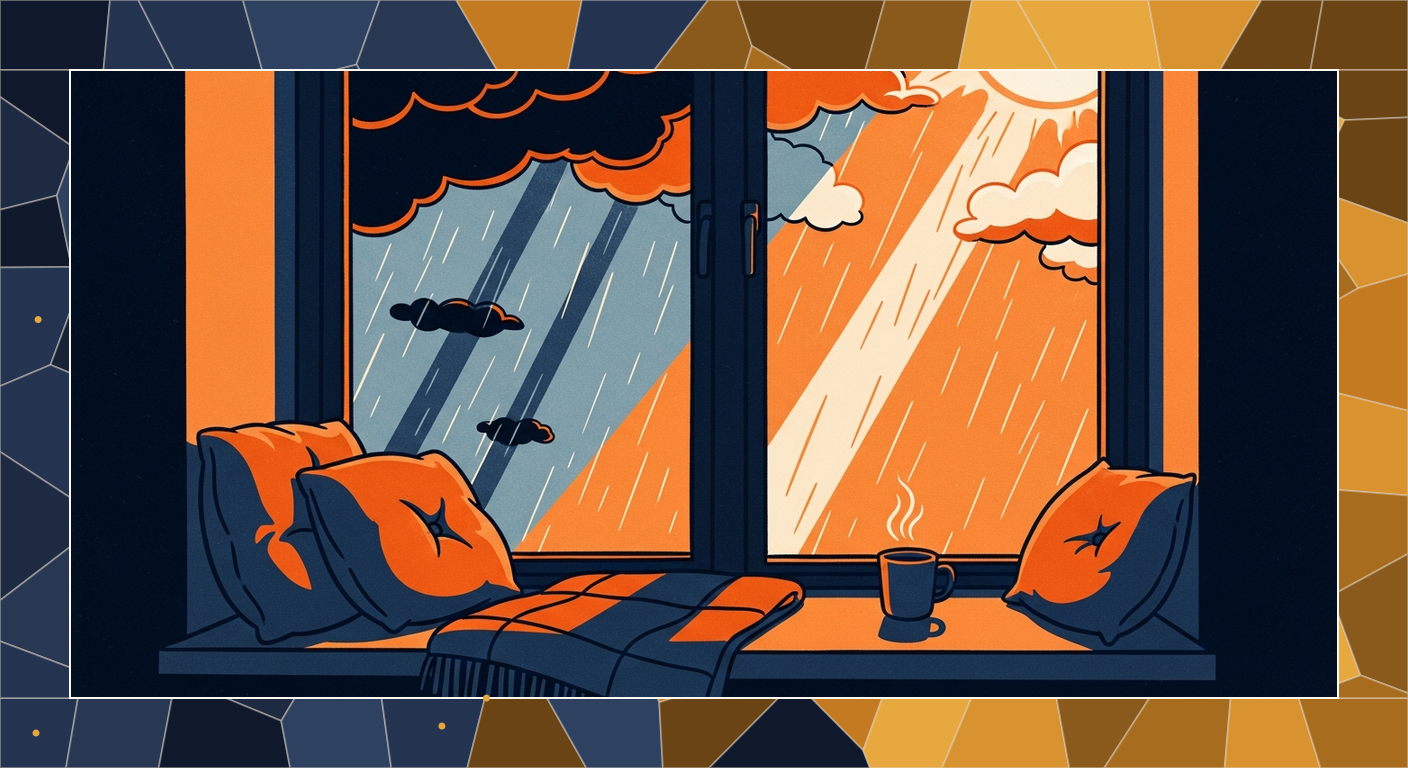
What the research says
This part of healing deserves more airtime. The emotional chaos you're feeling isn't something to fix. It's how recovery works.
Researchers call it the Dual Process Model. Originally developed for bereavement, it's been adapted for athletes losing their physical identity. And it says something that lets you off the hook: healthy coping requires oscillation. You move back and forth between grieving what you lost and building what comes next.
Not stages. Not a neat progression. Oscillation.
Athletes who fixate only on loss often slide into depression. Athletes who push grief aside and get on with it often collapse later. The people who heal look messy from the outside. Crying one hour, problem-solving the next, angry at breakfast, laughing at lunch.
That erratic pattern IS the pattern.
Your brain needs both modes:
- Loss-oriented: Feeling the grief. Acknowledging the anger. Sitting with the fear that you might never be quite the same.
- Restoration-oriented: Solving problems. Learning new things. Finding different ways to move through the world.
If you've been beating yourself up for not grieving properly, for being sad on Tuesday and weirdly hopeful on Wednesday, stop. You're not doing it wrong. You're doing it exactly right.
Playfulness is a clinical intervention, not a distraction
Scientists have identified four facets of adult playfulness. Athletes score especially high on one of them: the ability to see challenges as puzzles rather than tragedies. You've used that your whole athletic life. Now it's a clinical asset.
The four facets:
- Other-directed: Finding genuine enjoyment in interactions with your PT, your family, even your doctors
- Lighthearted: Treating recovery like a game to figure out instead of a punishment to endure
- Intellectual: Getting weirdly fascinated by tendon biomechanics or insulin physiology
- Whimsical: Finding dark humor in surgical scars, mobility aids, the complete absurdity of all of it
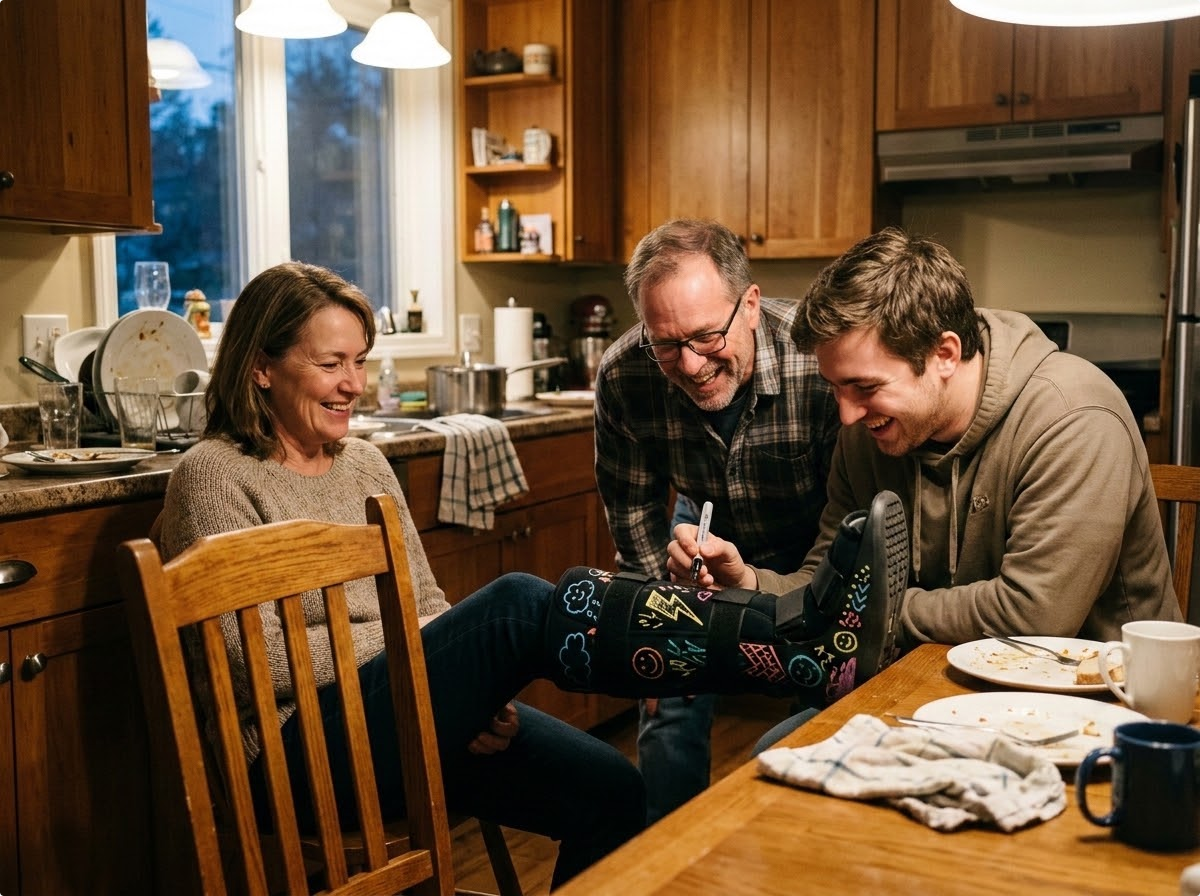
That last one matters more than it sounds. Laughter changes your physiology. It can lower cortisol and epinephrine, the same stress hormones driving your post-surgical blood sugar spikes. It lowers inflammatory markers like TNF-alpha and IL-6, the same inflammation slowing your healing tendon. And it reduces perceived pain intensity.
For someone with T1D healing a tendon, humor isn't fluffy self-care. It's an intervention you can give yourself for free.
So when you laugh at something dark, when you make a joke about your mobility aid that makes your family slightly uncomfortable, you aren't coping poorly. You're coping well. Your emotional life during recovery won't follow a neat arc, and it doesn't need to. You also lost your physical outlet for expression, and finding a creative one isn't a substitute for it. It's a different medicine entirely.
Run a two-minute weather report every day
Once a day, maybe at bedtime, maybe while your CGM charges, answer three questions:
- What did I grieve today? (loss-oriented)
- What did I build or solve today? (restoration-oriented)
- What made me laugh? (playfulness as medicine)
Two minutes. That's the whole ritual.
Over weeks you'll watch your oscillation pattern appear. The days that felt like pure chaos turn out to be days where grief and growth both happened. That's evidence you can look at instead of evidence you have to feel.
Recovery 'Diabetes-Boss' Select, this issue's interactive companion (all four bosses)

Recovery 'Diabetes-Boss' Select lets you pick the fight you're actually in, pain, blood sugar chaos, immobility, or family dynamics, and gives you strategies for that one. This issue, try all four bosses instead of just one.
Play it now, free on our site: https://explore.bettertogetherdiabetes.com/recovery/recovery-boss-select
Works in your browser, on your phone or computer.
Together This Week
Swinging between grief and problem-solving in the same hour is what healing looks like from the inside. It only looks like falling apart from the outside.
So give the report out loud this week instead of only writing it. Ask your family for theirs too, in the same three questions. A household that can say "scattered storms, and here's what made me laugh anyway" is doing the oscillation together instead of watching one person do it alone.
BTD Guide 4: The Uncertainty We Share teaches families that uncertainty asks for tolerance rather than resolution, which is the exact skill this issue has been describing.
Here's the whole script, if you want one. "My emotional weather today is scattered storms." Or partly cloudy. Or unexpected sunshine. Then: "What's yours?" Then, to one of your Better Together teammates, the question that does the most work of any of them. What made you laugh this week? Even if it was dark. Especially if it was dark.
Take care,
Trapper