
The moment
I do not want to be categorized as a limitation or as a hard case study. At the same time, being realistic about the reality of diabetes is something that needs to happen. There is nothing more physiologically obvious than what a changing glucose environment does to tendon, to muscle tissue, to circulation, to insulin efficacy.
So there was the double and the triple and the quadruple whammy: the changes already contributed over a long time, plus an acute state that was going to evolve into its own new state of challenge. Realizing that is the important step. You do not have to get to that level of detail. It is almost simpler than that. It just increases challenge.
And with something like an Achilles, up to a year, you get these subtle increments where staying immobile and tight is the important thing, and at the same time you are losing muscle. I wish I had known a little more at the time about doing other muscle activities across the rest of the body. I just did not get out to do it.
Somebody gave you a timeline. So many weeks in the cast, so many in the boot, a month when you're supposed to be walking, a season when this is supposed to be over. It came printed, or through a portal, or said fast at the end of an appointment while you were still putting your shoe back on. The question worth asking out loud is whose body that timeline was built for.
What the research says
Here's the walk-through worth having before surgery. The decision between surgical and conservative treatment looks different when you have diabetes.
Surgery cuts re-rupture from 3.9% to 2.3% and multiplies every other risk
The standard stat: surgical repair has a 2.3% re-rupture rate versus 3.9% for conservative treatment[1]. That 1.6% difference sounds meaningful until you see the other numbers.
Scar adhesion is nearly 12 times more likely with surgery[2]. Infection risk jumps almost 5 times higher[3]. Numbness and sensory changes around the scar, more than 7 times more common[2].
For people without diabetes those risks might be acceptable tradeoffs. For us they compound. The diabetic healing environment that makes our tendons rupture more easily in the first place can make surgical complications worse.
Four phases, four modifications your PT may not know
Whether you had surgery or chose conservative treatment, your rehab has four phases. Each one needs something added for diabetes.
Phase I (weeks 0-2): Acute protection. You're in a rigid cast, non-weight-bearing. The standard protocol assumes your foot will tell you if something's wrong. With diabetes, your foot might not. Peripheral neuropathy means a pressure ulcer can form without any pain signal[4]. Scheduled cast removal for skin checks isn't optional. It's protection.
Phase II (weeks 2-6): Early mobilization. Here's where the boot and heel wedges come in. Any healing Achilles can stretch too far and lengthen for good[5]. Push past the limit and the tendon settles in longer than it started, and you lose push-off power you don't get back. That risk applies to anybody healing a rupture. What diabetes adds is that your repair cells are already working against high glucose, so this is not a ceiling you want to go testing. Your dorsiflexion, meaning how far your foot flexes up, should never go past neutral. Not "a little past." Not "just to where you feel a stretch." Neutral. Full stop.
Phase III (weeks 6-12): Progressive loading. Time to transition out of the boot. This is where pre-existing foot issues, the ones diabetes creates over time, become urgent. Custom orthotics aren't a luxury here, they're injury prevention. And those lunges and squats your PT loves? The unremodeled diabetic tendon can't handle those loads yet. Bike and elliptical first.
Phase IV (months 3-6+): Late rehabilitation. Eccentric loading, those controlled heel drops off a step, is the standard late-phase move. It works well for non-diabetic tendons. Diabetic tendons repair micro-tears more slowly. The protocol needs modification: flat-ground exercises, more concentric work, sustained holds instead of aggressive drops.
Your mobility device can injure your good foot
If you're using a mobility device, the choice matters more than you think.
Knee scooters have a 43% fall rate. They also create the highest lateral shear forces on your good foot. That's a recipe for a diabetic ulcer on the one leg that's supposed to be healthy.
The iWALK hands-free crutch protects against blood clots by increasing blood flow in your leg. But it requires good balance and intact sensation. With moderate-to-severe peripheral neuropathy, it isn't safe.
Neither device is automatically right. Ask your PT about neuropathy specifically before you choose.
So your recovery timeline may run longer than the charts suggest, and that's biology rather than failure. Modern conservative treatment has closed the re-rupture gap[1], which means the surgical complications diabetes amplifies are often avoidable. Behind schedule compared to a non-diabetic timeline isn't behind. It's your schedule.
Bring the four-phase list to your first PT appointment
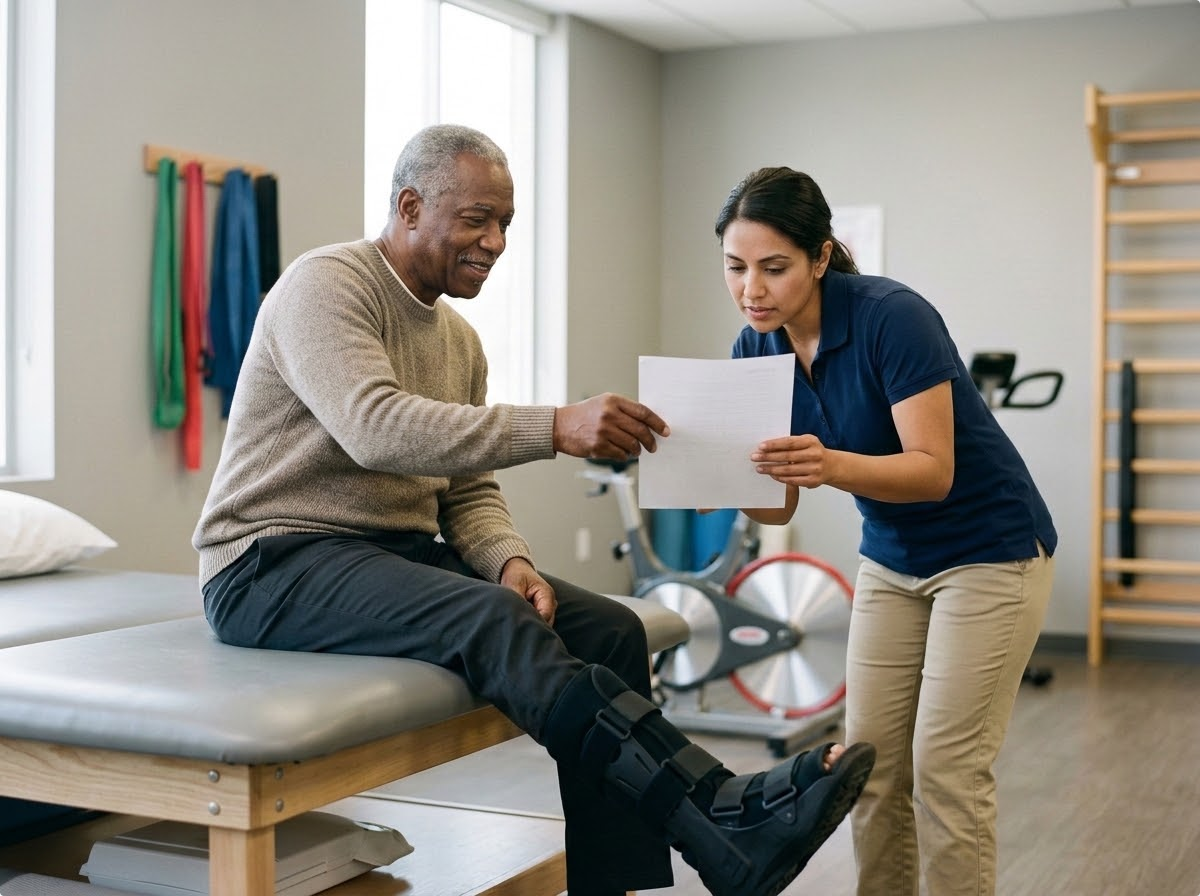
Print it. Then have this conversation: "Diabetes changes how my tendon heals, so a standard timeline may not fit me. Can we build these modifications into my rehab plan?"
Ask specifically about:
- Skin checks during immobilization
- Dorsiflexion limits during Phase II
- Custom orthotics for the boot-to-shoe transition
- Conservative eccentric loading for Phase IV
Most PTs don't see diabetic Achilles ruptures often. Your questions help them help you.
Together This Week
You already know how to work inside constraints your body sets. You've been practicing it for years.
So say the timeline out loud to one person this week, with the real number attached. "Months three to six is when this gets decided, and I'm going to be slower than the chart." The people around you are watching the same calendar you are, and right now they're using the wrong one.
BTD Guide 1: Surveillance to Support reframes tracking as a tool for decisions instead of a source of anxiety. Recovery is the hardest test of that, and the best practice for it.
Then ask what timeline they've been running. Most of the people around you picked up a number from somebody else's surgery. And ask the one underneath it: has a provider ever adjusted a plan for your diabetes without being asked, or has that always been your job? Their answer and yours together tell you what to expect from the next appointment.
Take care,
Trapper
Science & Research notes
Science works through iteration, meticulous perseverance, comparison, challenge, and identifying patterns across the spheres of science, so no single study is the whole answer. Findings come from other populations, animal models, or other tissues in the body, because living systems share enough molecules and machinery that these clues help us understand our own health. Individual papers are cited as keystones to stir thinking, and each one opens onto years of peer-reviewed work it was built on. Follow the citations when something is relevant to you: they open further readings you can bring to your care team. This is all part of being Better Together.
- Ochen et al. (2019), BMJ. Surgery vs nonsurgical treatment for Achilles rupture, meta-analysis. General population, not diabetes-specific. https://doi.org/10.1136/bmj.k5120
- Jiang et al. (2012), International Orthopaedics. Complications of surgical vs nonsurgical Achilles treatment, meta-analysis. The 7x figure is sensory disturbance, not structural nerve damage. https://doi.org/10.1007/s00264-011-1431-3
- Yang et al. (2025), Journal of Orthopaedic Surgery and Research. Complication rates after Achilles repair, meta-analysis. Superficial infection. https://doi.org/10.1186/s13018-025-05990-y
- Parveen et al. (2025), World Journal of Diabetes. Diabetic neuropathy and unnoticed pressure injury. https://doi.org/10.4239/wjd.v16.i3.100329
- Diniz et al. (2020), Knee Surgery, Sports Traumatology, Arthroscopy. Tendon elongation after Achilles rupture. General population, not diabetes-specific. https://doi.org/10.1007/s00167-020-06010-8
Next issue: what decades of blood sugar did to your tendon before it ever tore.