What the research says
It's easy to think of chair workouts as what you do when you can't do real exercise. A consolation prize. A placeholder until you can get back to the gym, back to the field, back to your actual life.
The numbers say otherwise, and they're kind of stunning.
This is the finding that matters most. In 32 inactive adults with Type 1 diabetes, interrupting a seven-hour sitting block with a 3-minute movement break every 30 minutes increased Time in Range by 13.7% and cut time above range by 15%. No meaningful increase in hypo risk[1].
Let me say that again. Breaking up the sitting, in three-minute pieces, improved glucose control better than sitting straight through. And it did that without the hypoglycemia spike that sends so many of us reaching for juice boxes mid-workout.
One thing I have to be straight with you about, because it is the difference between evidence and hope. That trial used self-paced walking for those three minutes, not chair exercise. I have not come across the same study run from a seated position, so I cannot tell you the chair version delivers the same 13.7%. What the trial establishes is the mechanism: short, frequent interruptions to stillness move the needle, and the dose is smaller than any of us assumed. What follows in this issue is my case that the chair is a reasonable way to deliver that dose when walking is not available to you. That case rests on the arm-work research below, not on SIT-LESS.
Your arms can do 65% of the work your legs do
Arm ergometry, basically an arm bike or any sustained upper-body work, reaches 65% of the oxygen consumption you'd get on a treadmill. Your heart rate hits 90-95% of predicted maximum. Your blood pressure response reaches 80-85% of treadmill levels.
This isn't gentle hand-waving. This is legitimate cardiovascular work that creates real physiological adaptations.
Seated boxing beats walking (seriously)
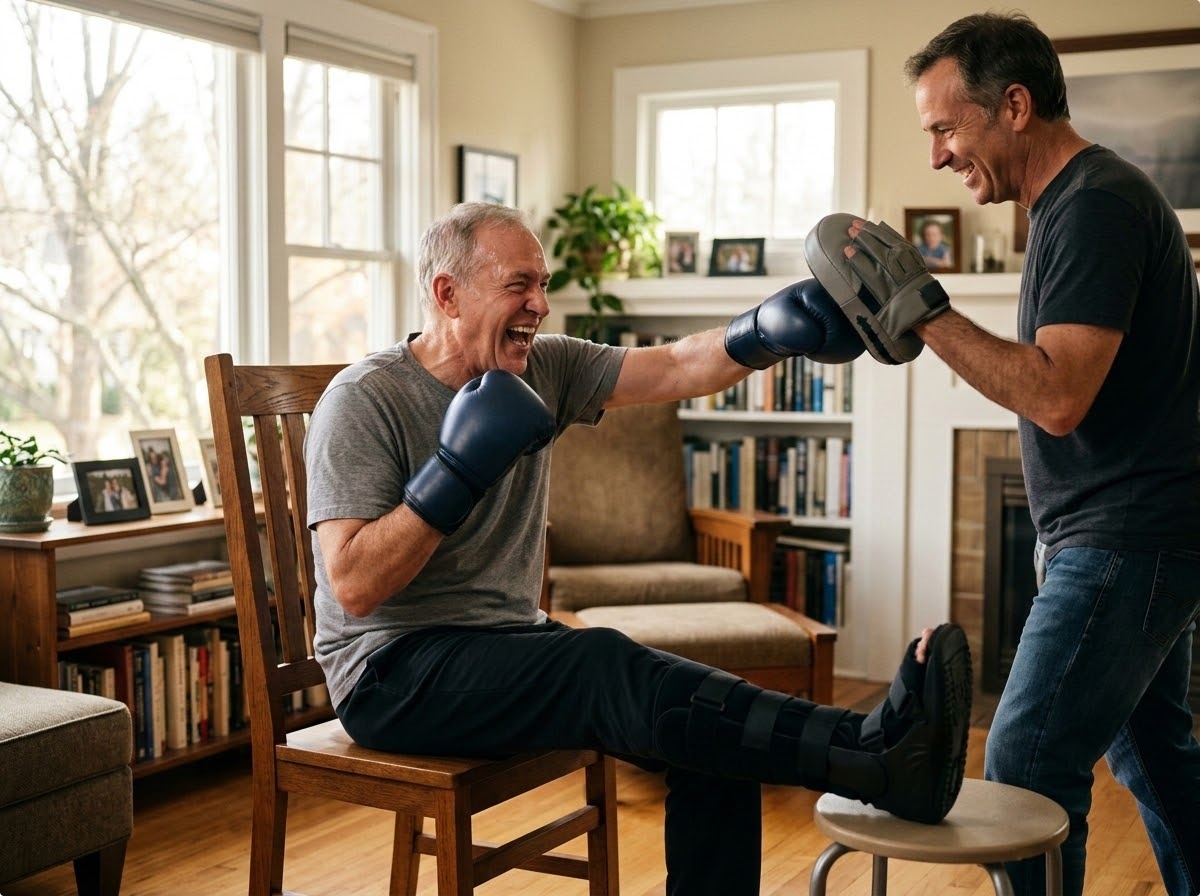
In a 12-week trial comparing seated high-intensity boxing against walking, the boxing group improved VO2 max, reduced body fat, lowered resting blood pressure, and improved arterial stiffness markers.
The walking group failed to improve on any of those measures. And had higher dropout rates.
Intensity matters more than position. Your heart doesn't care whether you're standing.
Short bursts protect you better than long slogs
Here's what makes this especially relevant if you're managing Type 1. Continuous moderate exercise carries significant hypoglycemia risk. We all know this. The long steady-state cardio everyone recommends is a blood sugar management nightmare for many of us.
But intermittent high-intensity upper-body work, like 4-second maximal seated sprints every 2 minutes, actually protects against blood sugar drops. The intensity triggers counter-regulatory hormones, epinephrine and glucagon, that maintain your liver's glucose output. The very thing that prevents the crash.
Seated HIIT may be metabolically safer than a long walk.
What SIT-LESS actually measured, using walking breaks[1]
- Mean glucose dropped from 148 to 124 mg/dL
- Time in Range increased 13.7%
- Time above 180 mg/dL decreased 15%
- Hypoglycemia showed no significant increase (6.0% vs. 4.6%)
- Inflammatory markers: TNF-α down 22%, PAI-1 down 42%, fibrinogen down 44%
Every number in that list came from walking breaks. I am listing them because they show how much a three-minute interruption is worth, not because a seated version has been measured to the same standard.
That last line deserves a translation. TNF-α is the inflammation signal that slows a healing tendon. PAI-1 and fibrinogen are the clotting side of your blood, and running high on those is exactly what you don't want while a leg sits still in a boot for weeks.
Chronic inflammation is part of why diabetes does long-term damage. Chair workouts aren't only managing glucose. They're fighting the underlying fire.
Your CGM gets less accurate during arm exercise
Median error reaches 32.1% during hypos with arm movement. Only 87% of readings are clinically safe during exercise, compared to 96% at rest.
That isn't a reason to skip the workout. It's a reason to keep your fingerstick meter nearby. When you're pushing hard with upper-body work, double-check a suspicious number before you treat it.
So you don't need to run to manage your blood sugar, and you don't need to stand. Your upper body, working from a chair, is enough to hold cardiovascular fitness, improve glucose control, and lower inflammation, without raising your risk of going low. Three minutes every thirty is a much lower bar than "exercise for thirty minutes," and the glucose benefit is real at that dose.
Set a 30-minute timer for your first week
When it goes off, do 3 minutes of anything upper-body: arm circles, rapid air punches, resistance band rows, seated jumping jacks with arms only. That's the whole protocol. SIT-LESS showed the three-minutes-every-thirty DOSE is enough to move glucose, using walking; the upper-body version of that dose is the part I am extending to you.
When you're ready for more, search YouTube for "Hurt Foot Fitness" by Caroline Jordan or "HASfit seated workout." Both are built for lower-limb injuries, and both understand that intensity from a chair is still intensity.
Race Against Atrophy, the interactive companion to this issue, lets you log these micro-workouts and watch them stack up. Small investments, visible returns.
Together This Week
Three minutes every thirty minutes moved Time in Range 13.7% with no added hypo risk[1]. That is a real intervention rather than a consolation prize, and the chair is how you deliver it when walking is not on the table.
So hand someone the timer this week. A kid who yells "three minutes" every half hour, a partner who does the arm circles with you at their desk, whoever's around. Seated boxing with somebody holding the pads is fitness, connection, and glucose management in one, and it's a lot easier to keep doing when you aren't the only one counting.
BTD Guide 5: Playing Together starts from the same place: movement isn't the gym or the sport you lost. It's what you can still do, done with people who matter.
Ask them what they'd actually be willing to do with you, and believe the answer. Arm circles at a desk. Pads held for seated boxing. A kid yelling the countdown from the next room. The version somebody volunteers for is the version still running on Thursday.
Take care,
Trapper
Science & Research notes
Science works through iteration, meticulous perseverance, comparison, challenge, and identifying patterns across the spheres of science, so no single study is the whole answer. Findings come from other populations, animal models, or other tissues in the body, because living systems share enough molecules and machinery that these clues help us understand our own health. Individual papers are cited as keystones to stir thinking, and each one opens onto years of peer-reviewed work it was built on. Follow the citations when something is relevant to you: they open further readings you can bring to your care team. This is all part of being Better Together.
- Campbell et al. (2023), Diabetes, Obesity and Metabolism. SIT-LESS randomised controlled trial. 32 inactive adults with type 1 diabetes, two 7-hour conditions, sitting uninterrupted versus interrupted every 30 minutes. The interruption was 3 minutes of self-paced WALKING, not seated exercise; the chair adaptation in this issue is my own extension and has not been tested to the same standard. https://pubmed.ncbi.nlm.nih.gov/37622406/
Next issue: fighting muscle loss when you can't use your legs, and which prevention strategies hold up under measurement.