
What the research says
Here's a number worth knowing before surgery. An immobilized leg is already measurably smaller by day two, and across that first week it loses muscle at close to 1% per day[1]. Strength falls even faster than size[2].
Those measurements come from healthy legs immobilized for a study, not diabetic ones[1]. With T1D the loss lands harder, because that muscle is your largest glucose-disposal organ. Every gram you lose makes your insulin work harder.
Within the first 48 hours, before you've even figured out how to shower with a cast, your body flips a biological switch[1]. The protein-building pathways shut down. The protein-destroying pathways take over. Your cells' power plants start failing. Your body begins digesting its own muscle fibers (which is as rude as it sounds).
This isn't gradual decline. It's aggressive breakdown. And for anyone managing T1D there's a direct metabolic consequence: less muscle means less glucose clearance, which means higher insulin resistance, which means harder-to-control blood sugar.
Here's where you get some control back.
Your good leg can protect your bad leg
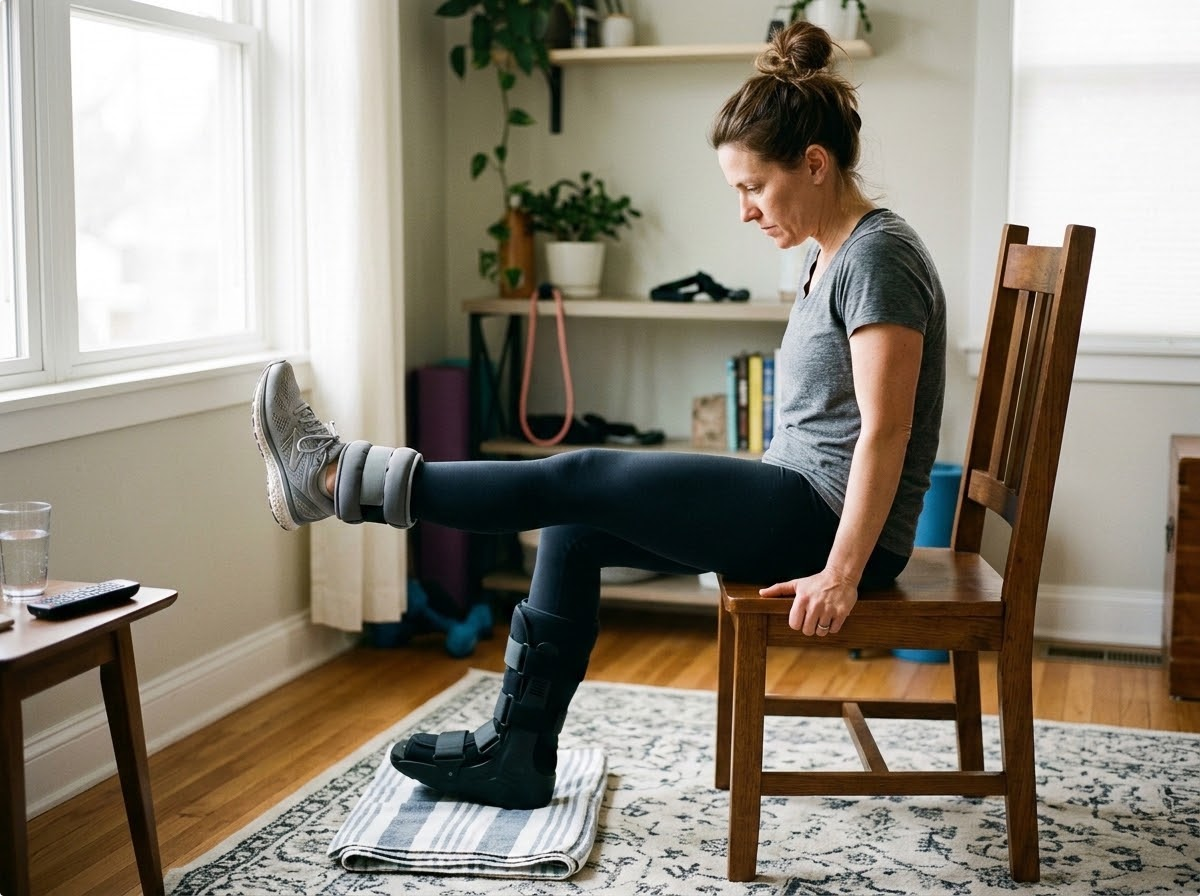
When you strength-train your uninjured leg, your immobilized leg loses less muscle.
Training one side sends protective neural signals to the other side. The mechanism is brain-based, not muscle-based. When you do seated leg extensions on your good leg, you aren't only keeping that leg strong. You're protecting the injured one from breaking down as fast.
Researchers call it the cross-education effect.
Your arms can protect your legs
When you do heavy upper-body work while your leg is immobilized, your working muscles release proteins called myokines into your bloodstream. These circulating signals tell your body to slow muscle breakdown, including in your immobilized leg.
Think of it as a "protect everything" message your working muscles send through your blood.
The mood drop is measurable, and so is the fix
Here's a stat that grounds what you might already be feeling. 48% of people with severe lower-limb injuries screen positive for a psychological disorder at 3 months. And 42% still do at 24 months.
But maintaining exercise, even seated exercise, reduces anxiety by 26% and depression by 24%. That's measurable brain chemistry. The same workout that protects your muscles releases BDNF, which helps your brain build new connections, IGF-1, which tells tissue to grow, and VEGF, which builds new blood vessels. All three support mental health. Your mood and your healing leg are asking for the same three things.
The mood lift isn't a nice bonus. It's part of the treatment.
So muscle loss during immobility isn't laziness. It's biology, and it starts on its own. You didn't cause it by being still. Stillness triggered it, and you can fight it from day one, from a chair, before you can put any weight on the injured leg. And the mental health benefit isn't a separate program. It's the same intervention doing two jobs at once.
Train your uninjured limbs starting week one
With surgeon clearance, start resistance training everything that isn't hurt, within the first week.
Good leg:
- Seated leg extensions
- Seated hip abductions
- Ankle weights
Upper body:
- Seated rows
- Chest press
- Overhead press with dumbbells or bands
The prescription: 3 sets per major muscle group, at least twice a week.
One technique that multiplies your effort: focus deliberately on the muscle during each rep. This mind-muscle connection increases recruitment by 20-60% without changing the weight. You aren't only moving. You're sending a stronger signal.
Race Against Atrophy, this issue's interactive companion
The Race Against Atrophy interactive tracks which muscle groups you've worked each day. It turns the daily fight against breakdown into something you can see.
Play it now, free on our site: https://explore.bettertogetherdiabetes.com/recovery/race-against-atrophy
Works in your browser, on your phone or computer.
Together This Week
Your body starts taking your muscle apart within 48 hours, and training the parts that still work slows it down everywhere, including the leg in the boot.
So invite one person to do the sets with you, twice this week. A kid on the resistance band next to you isn't keeping you company. They're in your treatment plan. Your family can't heal your Achilles, and they can absolutely be part of how you protect everything else.
BTD Guide 5: Playing Together is built on the finding that physical activity done together sticks better than exercise done alone. Recovery is when you need the company most and when the stakes are clearest.
While you're both sitting there, ask whether anybody on your care team mentioned training the side that still works. For most people the answer is no. Saying that out loud to somebody doing seated rows next to you turns a gap in your care into a thing the two of you handled.
Take care,
Trapper
Science & Research notes
Science works through iteration, meticulous perseverance, comparison, challenge, and identifying patterns across the spheres of science, so no single study is the whole answer. Findings come from other populations, animal models, or other tissues in the body, because living systems share enough molecules and machinery that these clues help us understand our own health. Individual papers are cited as keystones to stir thinking, and each one opens onto years of peer-reviewed work it was built on. Follow the citations when something is relevant to you: they open further readings you can bring to your care team. This is all part of being Better Together.
- Kilroe et al. (2020), Medicine and Science in Sports and Exercise. Muscle loss during short-term leg immobilization. Healthy adults, not people with diabetes. https://doi.org/10.1249/MSS.0000000000002200
- Appell (1990), Sports Medicine. Muscular atrophy after immobilization; strength declines fastest in the first week. Direction verified from the abstract. https://doi.org/10.2165/00007256-199010010-00005
Next in this series: NL-R13 on recovery nutrition, and the four supplements your care team probably didn't mention.