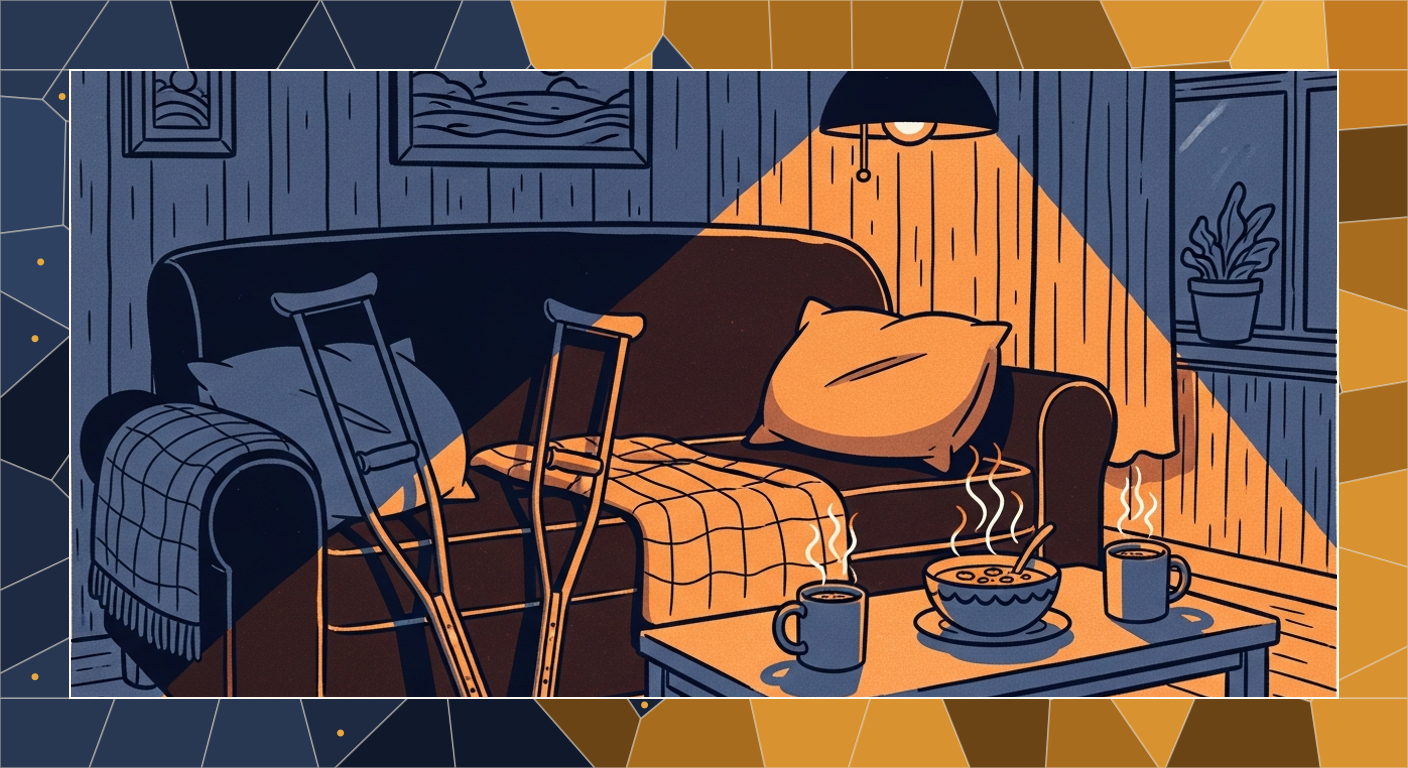
The moment
The biggest one was walking Buster, our Great Dane. Bubba. Those walks were a big part of my routine and a bigger part of his life. With everyone's schedules they got varied and intermittent, and my cardiovascular health and my time in nature dropped off with them. You could see he was a little saddened, wondering what was going on with me and our walks. My two sons picked up a bunch of that and adjusted their schedules to get him out.
I got home from surgery and had a work meeting that night, so I set up a new office corner with my leg up. That night I found a UK physical therapist on YouTube using a hands-free knee crutch. I ordered one and put it together the day it came.
That crutch got me back to breakfast. Two high schoolers out the door, open-face sandwiches built in layers: a sunny side up egg left slightly runny, a little cheese, a little beans, sometimes veggie sausages, vegetables and almond spread on top.
My sweetheart handled the low supplies, so every home base had what it needed. My mentality was how can I help the way I have always helped.
Somebody in your house took over a job this week without being asked. Maybe it's the driving. Maybe it's the stairs. Maybe it's the thing you used to handle at 6am that quietly stopped being yours somewhere around day two. That shift is worth saying out loud.
What the research says
When families treat injury recovery as a shared challenge instead of one person's problem, people stick with their rehab protocols[1]. But family support that feels like hovering makes outcomes worse.
That pair comes out of chronic-pain research, not tendons or diabetes. What carries over has nothing to do with tissue: the same family, in the same kitchen, deciding whether this is one person's problem.
Your family's stress response isn't separate from your healing. It affects it directly.
When psychological stress runs high and social support feels thin, your body creates localized hypoxia in wound beds, starving injured tissue of the oxygen it needs to repair. Sustained stress blocks the formation of new blood vessels that tissue needs to heal. A supportive partner buffers your stress response at the hormonal level, so healing can happen faster.
Only one of the three partner responses helps
Researchers watching couples live with ongoing pain found three distinct patterns in how the partner responds. That's a different setting than a ruptured Achilles, and the three patterns still apply.
Empathic responses. Active listening. Emotional validation. Encouraging you to do what you safely can. This pattern links to lower depression, less anxiety, and higher functional independence during recovery.
Punishing responses. Frustration. Irritation about the caregiving burden. Ignoring your complaints. This increases psychological distress and kills motivation to stick with rehab.
Solicitous responses. This one's tricky. The over-protective partner who constantly checks your pain levels and takes over every task you could safely attempt. It feels like love. But research shows it reinforces pain behaviors, promotes catastrophic thinking, and leads to avoiding rehabilitation activities[2].
You probably recognized that third one immediately. Maybe you've been on the giving end of it, or the receiving end, or both in the same week. Well-meaning over-protection can lead to physical deconditioning. It can turn an acute injury into a chronic problem.
Kids need a role, not a shield
When a parent is suddenly immobilized, children feel it hard. Loss of routine. Fears about whether this is permanent. Social disruption when activities get canceled.
The instinct is to protect them from the reality. But isolation makes their anxiety worse.
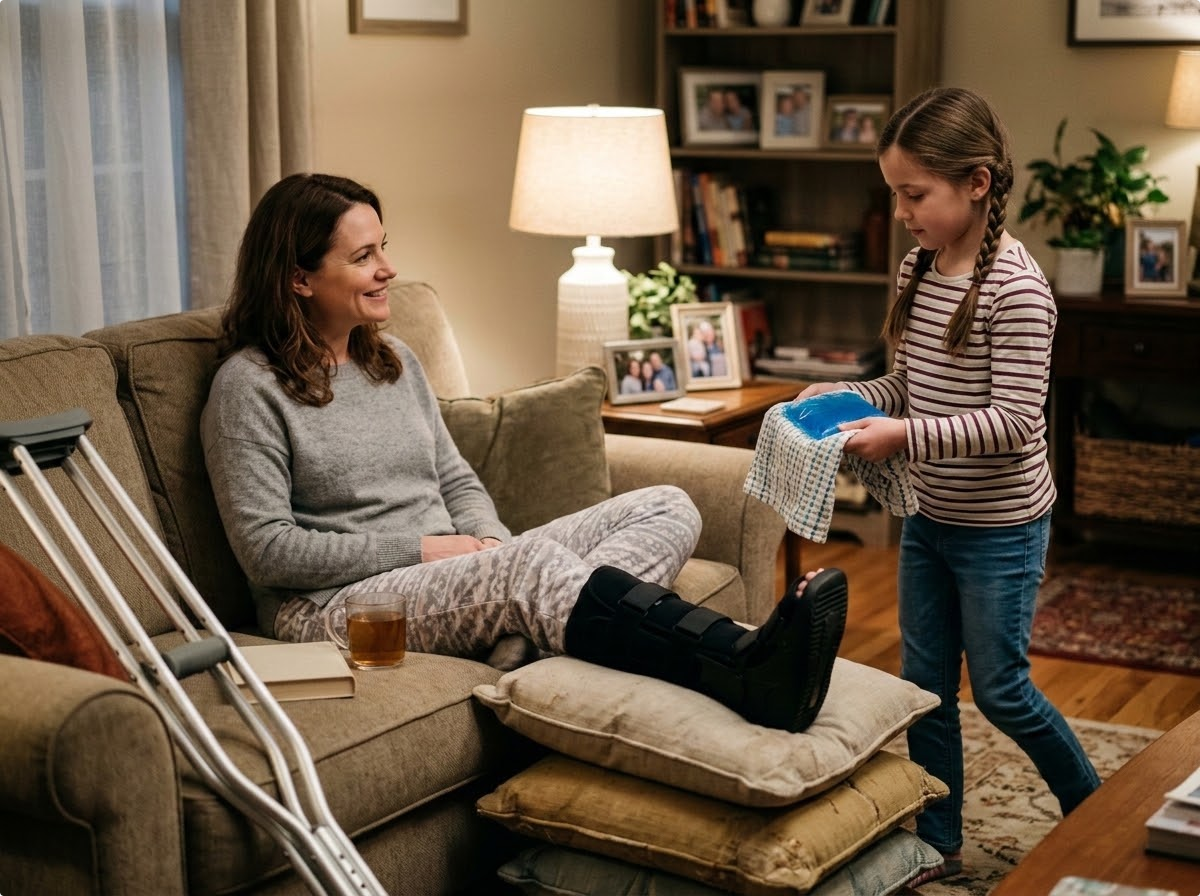
Children who get age-appropriate helping roles, fetching ice packs or joining modified activities alongside the recovering parent, report lower distress and a restored sense of control. The key is giving them responsibility for the solution, meaning the recovery process, and not for the problem, meaning the injury itself.
"We'll figure it out" is not a plan
Most families default to intuitive, trial-and-error caregiving with nothing written down. It leads to role confusion, caregiver burnout, and missed rehab milestones.
Structured family support, where caregivers understand the injury, know the expected pain trajectory, and learn the rehab protocol, outperforms both individual-focused treatment and the scramble.
That field-hospital staging I told you about in the first issue was hours of my sweetheart's life, spent on my injury before it had even happened.
So your family isn't on the sidelines of your recovery. They're in the game whether anyone planned for it or not. The question was never whether they'd be affected. It's whether you operate as a team with assignments or a crisis unit that re-improvises every morning.
Hold a family planning meeting in week one
Not a crisis conversation. A planning session. Cover three things:
- What does the recovery timeline actually look like? Share what your surgeon or PT told you. Real expectations, not optimistic guesses.
- Who is taking on which responsibilities, and for how long? Make it explicit. Write it down. Don't let it stay assumed.
- What does each person need during this time? Include the caregivers, who are carrying weight too, and name it out loud.
For kids, assign one specific recurring recovery-helper job. Fetching the ice pack every evening. Reading the CGM number at bedtime. Doing the seated warm-up exercises together before school. Small consistent roles beat vague availability every time.
Together This Week
Partner support isn't a nice-to-have. It's a clinical variable that reaches your healing tissue, and the most loving-looking response can be the one that hurts you.
So put the family meeting on the calendar this week and don't leave it until one job belongs to one person who isn't you. A kid who fetches the ice pack every evening. A partner who owns the PT schedule. A roommate who takes the Thursday grocery run. Thirty minutes and one assignment. That's the whole ask.
BTD Guide 3: Navigating Transitions is about how families renegotiate roles when illness disrupts everything at once. Recovery is one of those moments, and the families who have practiced this handle it with a lot less friction.
And while you have everyone in the room, ask the question the scramble never left space for: how did this house actually reorganize itself, and what would each of you do differently if it happened again? Everybody already has an answer. Nobody has been asked for it.
Take care,
Trapper
Science & Research notes
Science works through iteration, meticulous perseverance, comparison, challenge, and identifying patterns across the spheres of science, so no single study is the whole answer. Findings come from other populations, animal models, or other tissues in the body, because living systems share enough molecules and machinery that these clues help us understand our own health. Individual papers are cited as keystones to stir thinking, and each one opens onto years of peer-reviewed work it was built on. Follow the citations when something is relevant to you: they open further readings you can bring to your care team. This is all part of being Better Together.
- Meints and Edwards (2018), Progress in Neuro-Psychopharmacology and Biological Psychiatry. The communal coping model in chronic pain. A framework review; it reports no effect sizes. https://doi.org/10.1016/j.pnpbp.2018.01.017
- Hemphill, Martire, et al. (2016), Health Psychology. Solicitous partner responses and physical function after knee surgery. Partial support; one pattern, not all three. https://doi.org/10.1037/hea0000383
Next issue: the support that predicts you go back to work, and the support that predicts you don't.