
When the plan on paper meets the human in the building
There's a 504 plan somewhere in the system. It's got your child's name on it, a list of accommodations, and signatures from people who want to do right.
And then there's Tuesday at 11:30, when the aide is covering three buildings and your kid's blood sugar drops in the middle of math class.
The gap between the document and the human: that's what we're talking about today.
The Moment
You've done the paperwork. You've attended the meetings. You've provided supplies, instructions, emergency contacts, the works.
And still, in the quiet of your car after drop-off, you wonder: Will they actually read it? Will they remember when it matters? Will someone notice if something's wrong?
The 504 plan is a legal document. But trust isn't built in binders. Trust is built in the small moments: the nurse who texts you after a tough day, the aide who remembers your kid's name, the teacher who notices something's off before the numbers do.
The Gap
Here's what parents figure out fast: A plan in the system isn't the same as a plan in action.
The nurse might cover multiple buildings. The teacher might have 25 kids and a new curriculum. The aide might have been hired last week. Everybody means well. But the nuances of your child are not in a training manual: the specific signs of their low, what actually helps them feel steady.
The document says what should happen. The humans in the building decide what actually happens.
And the bridge between those two things? That's a conversation. Usually more than one.
Multiple Perspectives
If you're the parent:
You've done everything you were supposed to do. But you've also learned that following procedures doesn't guarantee understanding. What you want isn't a building full of people who've read the plan. What you want is one or two people who get your kid, who would notice something's wrong, who would call you in time, who would handle it calmly.
If you're the student:
The nurse's office can feel like a refuge or a prison. A place to go when you need help, or a place you're sent when adults are nervous. You might want independence. You might want someone who just knows without having to explain every time. The relationship with school health staff is one of the first "outside the family" diabetes relationships you'll learn to manage.
If you're the school nurse or health aide:
You're responsible for dozens (sometimes hundreds) of students with different health needs. The diabetes training you got was a workshop three years ago, and the specifics of each kid's management weren't covered. What you wish is that parents would tell you the real version: What does THIS child look like when they're low? What actually helps?
If you're the teacher (who also happens to have diabetes):
I've been here. There's something different about connecting with a student who's going through what you've lived. The clinical support from the nurse is important. But the quiet nod from another person who gets it? That's its own kind of safety net.
What Actually Helps

The parent who shared the human version:
Instead of just submitting the 504 plan, one parent sent a short email: "Here's who my kid is: they're shy, they like to handle things quietly. Here's what a bad day looks like: they get quiet, they can't focus. Here's what actually helps: a juice box and 10 quiet minutes. Here's what doesn't help: making them go to the office for every blood sugar check."
That email did more than the binder.
The nurse who became a partner:
At one school, the nurse didn't just keep supplies. She learned the patterns. She noticed that Monday mornings were always rough (weekend routines are different). She started checking in on Mondays, not because the plan required it, but because she paid attention.
She became someone the student trusted enough to say, "I'm having a bad day and it's not about my numbers."
That's not policy. That's partnership.
The teacher who didn't need the plan:
Sometimes support comes from unexpected places. Another adult in the building who lives with diabetes, who recognizes the lingering after class, who says "Take your time" without needing to know what's happening.
You can't plan for that. But you can create space for it by helping kids know: There might be people in this building who understand more than you think.
The Itinerant Nurse Reality
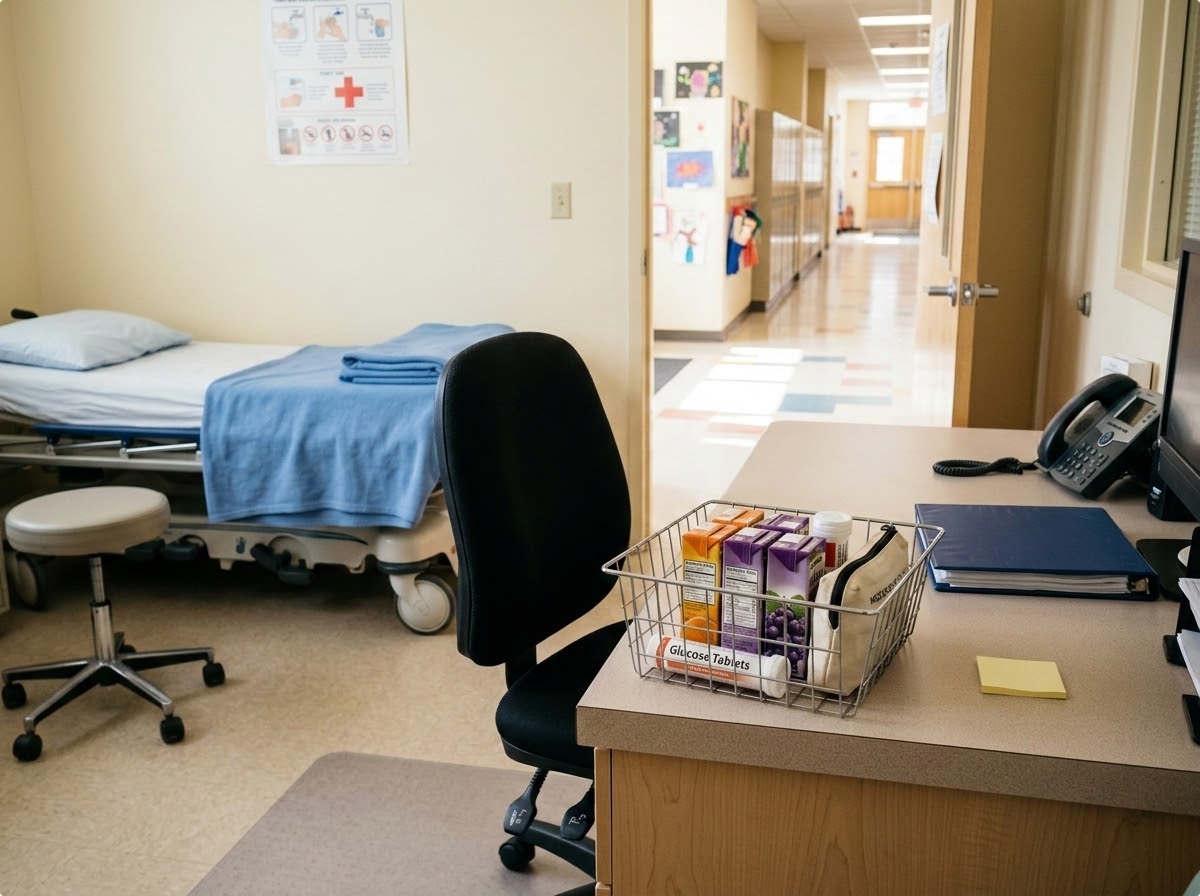
Not every school has a full-time nurse. Some have traveling health staff who cover multiple buildings. That means some days, nobody who really knows diabetes is on-site.
If this is your situation:
- Find out who the backup is when the nurse isn't there
- Ask: Can my child reach health support on off-days? How?
- Consider providing supplies to both the health office AND a backup person (like a trusted teacher or the front office)
- Practice with your child: If the nurse isn't here and you need help, what do you do?
The plan needs to account for the real schedule, not the ideal one.
The 504 Plan Conversation
A quick word on 504 plans: They matter. They're legal protections. They document what your child needs.
But here's what I've learned: The best plans come with a human conversation. Not instead of the document, alongside it.
The document says what accommodations exist. The conversation says who your child is, what they actually need, and how to make everyone's job easier.
Send the plan. Then send the email. Then ask for 5 minutes.
The Reframe
FROM: "The plan is on file, so they should know what to do"
TO: "The plan opens the door. The conversation builds the trust"
Paperwork establishes the floor. Relationships raise the ceiling.
This Week's Activity: The Communication Bridge
This activity helps families and school staff practice seeing from each other's perspectives.
Three roles: Parent, Student, School Support Person. Each gets a card with their concerns. A scenario goes in the middle. Everyone states their concern, then works together to find the overlap.
The conversation reveals how differently the same situation looks from different angles, and where the solutions live.
Download the Communication Bridge Game →
Things to Do Together
- Send the "human version" email before the first week
- Identify who the backup is when the nurse isn't on-site
- Schedule a 5-minute face-to-face in the first week
- Create a Classroom Quick Sheet for the teacher's desk (not posted publicly, just accessible)
Things to Ask
- "Who should my child go to if the nurse isn't here?"
- "What's the best way to update you if something changes?"
- "What information would help YOU feel prepared?"
- "Is there anything that's unclear in the plan?"
Things NOT to Say
- "The 504 plan explains everything"
- "You should have read the file"
- "This is your job"
- "Why didn't you call me sooner?"
Everyone's trying. The gap between the document and the reality isn't anyone's fault. Bridging it is a shared project.
Shows of Support
The nurse who texts after a hard day: "Just wanted to check in, they seemed better by afternoon."
The teacher who pulls the parent aside: "I noticed something off this morning. Everything okay?"
The aide who remembers the preferred snack.
Support looks like paying attention, not just following instructions.
You're already connected
You already know people going through this: another parent at pickup, a teacher who mentioned a student with a health plan, a school nurse building partnerships one family at a time. You're already connected to people who need what you're learning. When something from this issue makes a difference, share it with one of them. The best way you can help me is to help somebody else.
The Bigger Truth
Here's what I want you to know: The people in your child's school want to help. Most of them, anyway. But they're working with limited time, limited information, and a lot of other demands.
Your job isn't to make them experts. Your job is to help them become partners.
That means sharing the human version. That means asking what they need. That means following up, not to check on them, but to build the relationship.
The 504 plan says your child has accommodations. The partnership you build says your child has people who care.
What's inside the full guide
You've just read 2 of 10 issues in Navigating Transitions Together. Here's the full arc: the transitions this guide walks through with you.
| | Issue | What it's about |
|---|-------|----------------|
| ✓ | 1. First Day Back | Walking into a room full of people who don't know what changed over the summer |
| ✓ | 2. The School Nurse Conversation | When the plan on paper meets the human in the building (you're here) |
| | 3. Moving Out | When shared tasks become 100% yours and the safety net dissolves |
| | 4. The Question Flip | The moment you stop being asked about your diabetes and start asking for help |
| | 5. First Serious Relationship | When and how you let someone new into this part of your life |
| | 6. Moving In Together | What changes when someone is around all the time |
| | 7. Becoming a Parent | When you're suddenly responsible for someone else, and still managing yourself |
| | 8. New Job Navigation | Being the new person again, deciding who to tell and when |
| | 9. Loss and Grief | When you can barely manage yourself, and the numbers still don't stop |
| | 10. The Renegotiation That Never Happened | Looking back at the conversations we missed, and having them now |
Every issue includes activities, conversation starters, and a discussion guide. The full guide also comes with digital interactives (like the Transition Timeline Builder and Support Network Mapper), video walkthroughs, and downloadable resources for every stage.
This guide walks beside you through all of it.
What's Next
Next issue: "Moving Out". What happens when the safety net at home dissolves, and everything you used to share becomes 100% yours.
Until then: The document opens the door. The conversation walks through it. And the partnership you build today is one more skill for every transition that follows.
Trapper