When you're responsible for someone else
The baby is crying. Your blood sugar is dropping.
And for one impossible moment, you have to choose: Take care of them, or take care of yourself.
You know the right answer. You've heard it a hundred times: Put your own oxygen mask on first. You can't care for anyone if you're crashing.
But here's what they don't tell you about that rule: When the baby is screaming and you're shaking from a low, nothing feels more selfish than stopping to take care of yourself.
The Moment
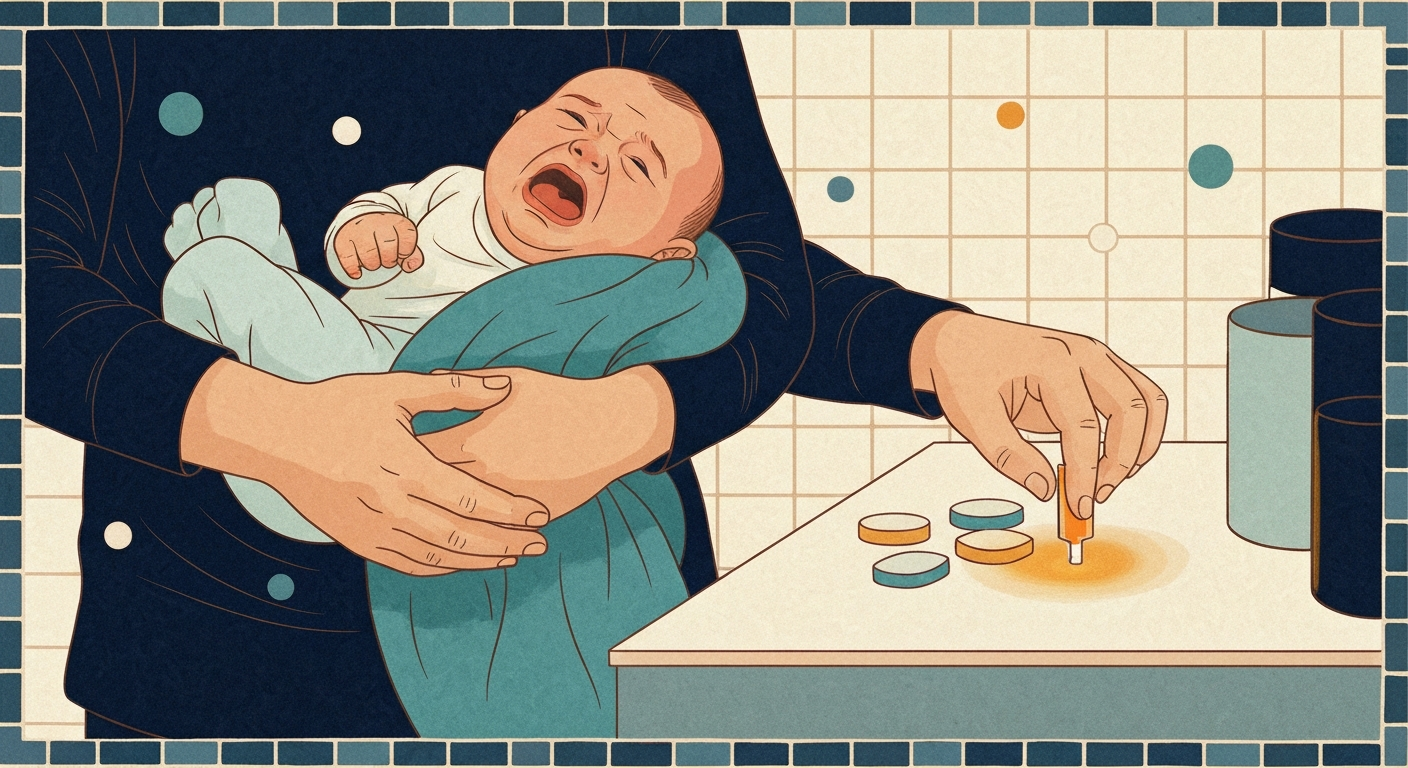
Parenthood rewrites priorities.
Before the baby, your diabetes came first because it had to. You ate when you needed to. You checked when something felt off. You rested when the numbers demanded it.
Now there's someone who needs you constantly. Someone who doesn't understand that you need five minutes to drink juice. Someone whose cry rewires your brain to respond instantly, even when your own body is sending alarms.
And suddenly, the systems you built for yourself don't fit anymore.
What Changes
Here's what parenthood does to diabetes management: Everything competes for the same limited resource: you.
Things that used to be automatic now require negotiation:
- Meal times (what meal times?)
- Sleep (what sleep?)
- Checking numbers when you feel off (while holding a baby?)
- Going to appointments (with what childcare?)
- Taking a moment to recover from a low (when they're still crying?)
The math changes. You used to be the only variable. Now you're one of two, and the smaller one is louder.
Multiple Perspectives
If you're the parent with diabetes:
You feel guilty for needing things. For having a condition that takes time and attention. For every moment you can't give fully to your child because your body is demanding something else. You know the oxygen mask rule. You know taking care of yourself IS taking care of them. But in the moment, it doesn't feel that way.
If you're the co-parent:
You see them struggling. You want to help. But you're also exhausted, and the division of labor is already stretched. When they need to step away to manage a low, you're picking up the slack. When they're running on too little sleep and their numbers are chaotic, you're worried. You want them to take care of themselves, and you're not sure how to make that possible.
If you're the grandparent or extended family:
You want to help. But you don't know what's needed. You bring food (is it the right kind?). You offer to take the baby (but they're breastfeeding). You ask how they're doing (and they say "fine" even when they're not). You want to support. You just need to know how.
What Actually Helps
The partner who took the baby:
Not asked. Just noticed. "You look like you need five minutes. I've got this."
That's it. No negotiation. No guilt. Just: I see you. Take a moment.
The grandparent who brought the right food:
"I brought soup, and I checked, it works for your blood sugar. There's also juice in the bag in case you need it. I'm here for two hours. What do you need me to do?"
That's specific. That's informed. That's showing up ready to actually help.
The new parent who asked for what they needed:
"I need someone to hold the baby between 2 and 3 PM so I can go to my endo appointment. Not offer. Actually do. Can you?"
Asking isn't weak. Asking is how support happens.
The Convenience Foods Reality
Let's talk about what you're actually eating.
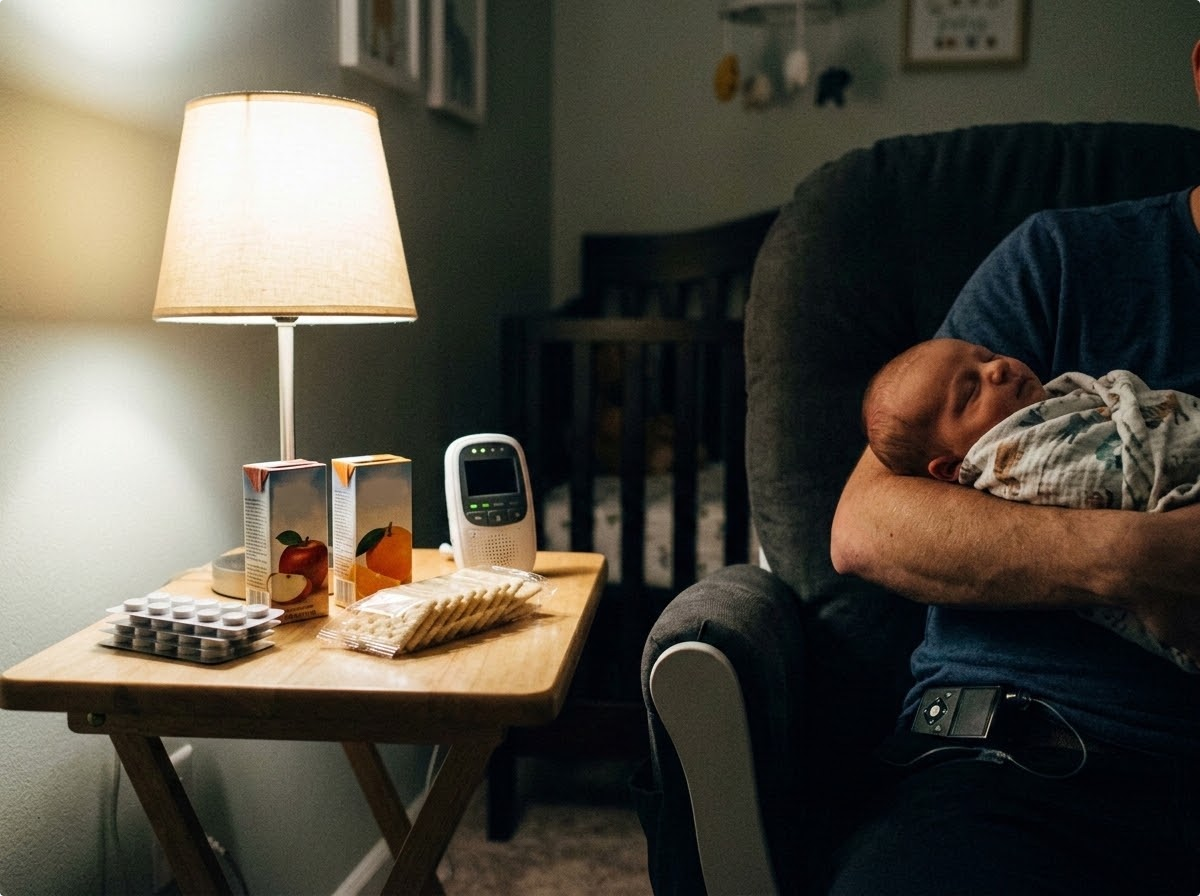
When you're holding a baby with one arm, you need food you can eat with one hand. When you're sleep-deprived and low, you need sugar that's instantly available.
Here's what works:
- Sweet Tarts and similar candy: treat it like medicine, because it is
- Glucose tabs in every room, in stacks of 4-5 doses
- Juice boxes you can open with your teeth
- Snacks that don't require cutting, assembling, or thought
Perfect nutrition can wait. Right now, survival is the goal.
The Support Schedule
Newborn life is chaotic. But diabetes doesn't take a break for chaos.
What helps: Building protected time into the schedule. Not extra time, just designated time.
Sample approach:
- Tuesday at 2 PM: Grandma has the baby so I can go to my appointment
- Every morning: Partner handles first feeding while I eat breakfast and check numbers
- Thursday afternoon: Friend brings food that actually works for my blood sugar
- Anytime: Easy snacks accessible within arm's reach of everywhere I nurse/feed
The schedule isn't about perfect management. It's about making sure you don't completely disappear into the role of parent.
And when travel enters the picture (visiting family with a newborn, a first vacation as new parents), the support schedule becomes even more important. Pre-trip planning with someone who knows both baby logistics AND diabetes logistics can make the difference between a trip that works and one that breaks you. Some families find that building travel into their support network early (a grandparent who travels with them, a friend who helps plan) creates patterns that last well beyond the newborn stage.
The Reframe
FROM: "I can't focus on my diabetes when my child needs me"
TO: "Taking care of my diabetes IS taking care of my family"
You can't pour from an empty cup. You can't care for a baby while crashing from a low. Protecting your health isn't selfish. It's survival.
This Week's Activity: The Support Schedule
Map a typical week. Mark:
- When do you need protected time for diabetes (appointments, supply ordering, rest)?
- When is someone else available to take the baby?
- What would fill the gaps?
Give this schedule to someone who wants to help. Let them fill a slot.
Download the Support Schedule Activity →
Things to Do Together
- Explicitly discuss who handles what, both baby AND diabetes tasks
- Build in "you time" even if it's just 15 minutes
- Stock easy food in multiple locations
- Create a "what I actually need" list for people who offer to help
Things to Ask
Ask the new parent:
- "What do you need from me to take care of yourself?"
- "What's slipping that we should address?"
- "What would make the hardest part of the day easier?"
Ask the support person:
- "What time could you take the baby this week so I can [specific thing]?"
- "Can you bring food? Here's what works for my blood sugar."
- "I need you to not ask about my numbers right now, just be present."
Things NOT to Say
- "Your blood sugar can wait"
- "You're always checking your phone/monitor"
- "The baby comes first"
- "Just let me know if you need help" (be specific instead)
- "You look like you're managing fine"
New parents with diabetes are rarely managing as well as they look. Offer concrete help, not open-ended invitations.
Shows of Support
Support for new parents with diabetes looks like:
- Taking the baby without being asked
- Bringing specific food that works for them
- Showing up at a scheduled time, ready to help
- Noticing when they're struggling (even when they don't say it)
- Saying: "Your health matters. Let me take over for a bit."
Pass it along
If something in this issue clicked for you (the oxygen mask reframe, the support schedule idea, the permission to ask for help), the best way you can help me is to help somebody else. You don't need to explain it perfectly. Just pass along what helped. That's how this community grows: one conversation at a time.
The Bigger Truth
Here's what I want you to know: Becoming a parent with diabetes is one of the hardest transitions.
Not because you can't do it. You can. But because everything you've built for yourself now has to compete with someone who needs you more than you've ever been needed.
The oxygen mask rule is real. Taking care of yourself IS taking care of your child. But living that rule, in the moments when the baby is crying and your blood sugar is crashing? That takes help.
You can't do this alone. You weren't meant to. The people who love you are waiting to step in. Let them.
What's Next
Next issue: "New Job Navigation". How do you build workplace support without making diabetes your identity? Disclosure, allies, and the strategic decisions of professional life.
Until then: The baby will cry. Your blood sugar will crash. And somewhere in between, you'll figure out how to take care of both, with help from the people who are ready to hold the baby while you hold yourself together.
Trapper